Wealthsimple TFSA
A Tax-Free Savings Account is the single best place for most Canadians to start investing, every dollar of growth and every withdrawal is 100% tax-free. Open one with Wealthsimple and claim $25 using code _Y024Q.
A TFSA isn't a savings account in the boring sense, it's a tax shelter you can fill with cash, ETFs, individual stocks, or a managed portfolio. Whatever it earns inside is never taxed, and you can pull money out any time without penalty.
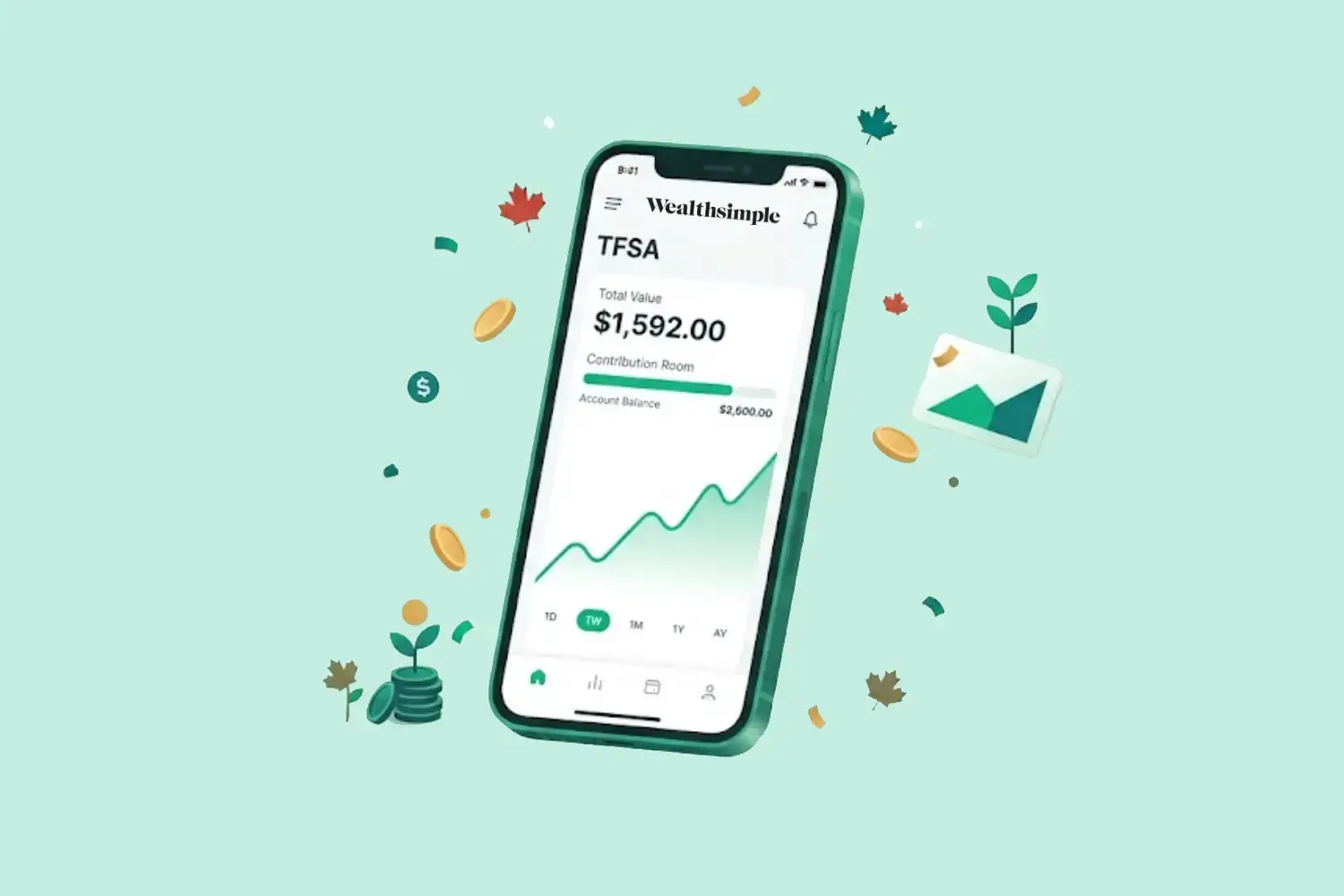
How a TFSA works
Despite the name, a Tax-Free Savings Account is far more than a savings account, it's a registered "wrapper" you can place around almost any investment. You contribute money you've already paid income tax on (after-tax dollars), and from that point forward the Canada Revenue Agency (CRA) leaves everything inside completely alone:
- Growth is 100% tax-free, interest, Canadian and foreign dividends, and capital gains are never taxed inside the account.
- Withdrawals are tax-free, take money out any time, for any reason, with no tax and no penalty. There's no minimum holding period.
- Withdrawn room comes back, any amount you withdraw is added back to your contribution room on January 1 of the following calendar year.
- It doesn't affect benefits, because withdrawals aren't taxable income, they don't claw back income-tested benefits like OAS, the GST/HST credit, or the Canada Child Benefit.
That last point is what makes the TFSA so powerful over decades. A $7,000 contribution that grows to $30,000 can be withdrawn in full with zero tax owing, something no RRSP or non-registered account can match.
What you can hold inside a TFSA
A common misconception is that a TFSA can only hold cash. In a Wealthsimple TFSA you can hold a wide range of "qualified investments," including:
- Stocks, Canadian and US equities, traded commission-free.
- ETFs, low-cost index funds covering Canadian, US, and global markets.
- Fractional shares, slices of expensive stocks starting at $1.
- A managed portfolio, a diversified, auto-rebalanced basket of ETFs matched to your risk level.
- Cash earning interest, if you simply want a high-interest holding spot.
One thing to note: certain US dividends paid into a TFSA may have a 15% US withholding tax that you can't recover, so for US dividend-focused investing an RRSP can be more efficient. For Canadian dividends, capital gains, and broad growth, the TFSA is hard to beat.
Contribution limits & how room builds
The federal government sets an annual TFSA dollar limit, and any room you don't use carries forward indefinitely. You start accumulating room the year you turn 18 and become a Canadian resident, even if you never open an account. Here's how the annual limits have stacked up:
| Years | Annual TFSA limit |
|---|---|
| 2009–2012 | $5,000 |
| 2013–2014 | $5,500 |
| 2015 | $10,000 |
| 2016–2018 | $5,500 |
| 2019–2022 | $6,000 |
| 2023 | $6,500 |
| 2024–2026 | $7,000 |
If you've been eligible since the TFSA launched in 2009 and have never contributed, your cumulative room is well into the six figures. Your exact, personal number is the only one that matters, find it in CRA My Account or on a recent CRA notice before you max out.
Over-contributing triggers a penalty of 1% per month on the excess amount until you withdraw it, so always confirm your room with the CRA rather than estimating from memory.
Withdrawals & the re-contribution rule
You can withdraw from your TFSA whenever you like, but the timing of re-contributing trips a lot of people up. Here's the rule in plain English: when you withdraw, that amount is only added back to your room in the next calendar year. If you withdraw $10,000 in March and re-deposit it in November of the same year, without having the room, you'll over-contribute and face the 1% monthly penalty.
Example: Maria withdraws $8,000 from her TFSA in 2026 to cover a car repair. She can re-contribute that $8,000 starting January 1, 2027 (on top of the new 2027 annual limit), but not before, unless she already has unused room available in 2026.
How to open a Wealthsimple TFSA
Opening a TFSA takes about five minutes, and doing it through a referral link lets you claim the $25 bonus at the same time:
- Open the invite link wealthsimple.com/invite/_Y024Q to attach code _Y024Q.
- Create your account and verify your identity with photo ID and your SIN.
- Select TFSA as your account type (you can open more than one account).
- Choose self-directed or managed, then make a deposit of at least $100 from an external bank.
- Your $25 bonus lands in your Chequing account within 24 hours of the deposit settling.
Need the full walkthrough? See our step-by-step guide to claiming the bonus.
Open a TFSA and pocket $25 to start it off.
Open a TFSA with code _Y024QManaged vs self-directed: which TFSA is right for you?
Wealthsimple offers two ways to run a TFSA, and you can even hold both:
| Feature | Managed TFSA | Self-Directed TFSA |
|---|---|---|
| Best for | Hands-off investors | DIY investors |
| Who picks investments | Wealthsimple (auto) | You |
| Rebalancing | Automatic | Manual |
| Management fee | 0.4–0.5% / yr | $0 (commission-free trades) |
| Effort required | Minimal | Moderate |
If you're new to investing or simply don't want to think about it, the managed option is the easiest path. If you're comfortable buying a couple of broad index ETFs yourself, the self-directed account keeps your costs as close to zero as possible.
5 common TFSA mistakes to avoid
- Re-contributing too early, wait until the next calendar year for withdrawn room to return.
- Day-trading inside a TFSA, frequent, business-like trading can lead the CRA to tax your account as business income.
- Holding only cash long-term, for multi-year goals, investing usually beats leaving it idle.
- Overlooking US dividend withholding tax, consider holding US dividend payers in an RRSP instead.
- Guessing your contribution room, always confirm in CRA My Account to avoid penalties.
Does the $25 bonus use up my TFSA room?
No, and this is the clever part. Wealthsimple pays the referral bonus into your Chequing account, not your TFSA. That means the $25 has zero impact on your TFSA contribution room. You get the full bonus and keep every dollar of your tax-free room intact. The same is true for your RRSP and FHSA room.
TFSA vs RRSP vs FHSA: which first?
A rough rule of thumb: use a TFSA for flexible, all-purpose investing and any goal where you might need the money back; an RRSP when you want an immediate tax deduction (especially at higher incomes); and an FHSA if you're saving for your first home, since it combines the RRSP deduction with TFSA-style tax-free withdrawals.
| TFSA | RRSP | FHSA | |
|---|---|---|---|
| Tax deduction on deposit | No | Yes | Yes |
| Tax-free withdrawals | Yes | No (taxed) | Yes (for a home) |
| 2026 contribution limit | $7,000 | 18% of income* | $8,000 |
| Best for | Any goal | Retirement | First home |
*Up to the annual RRSP maximum. Many Canadians use all three, and every one of them qualifies for the $25 referral bonus.
Wealthsimple TFSA questions
The most common questions Canadians ask about the Wealthsimple TFSA and the $25 bonus.