Wealthsimple RESP
The Registered Education Savings Plan is the single best way to save for a child's education in Canada, because the government pays you to use it. Open one and claim $25 with code _Y024Q.
If you're saving for a child's post-secondary education, an RESP should almost always come before a regular investment account: it's the only account where the federal government tops up your contributions with free grant money.
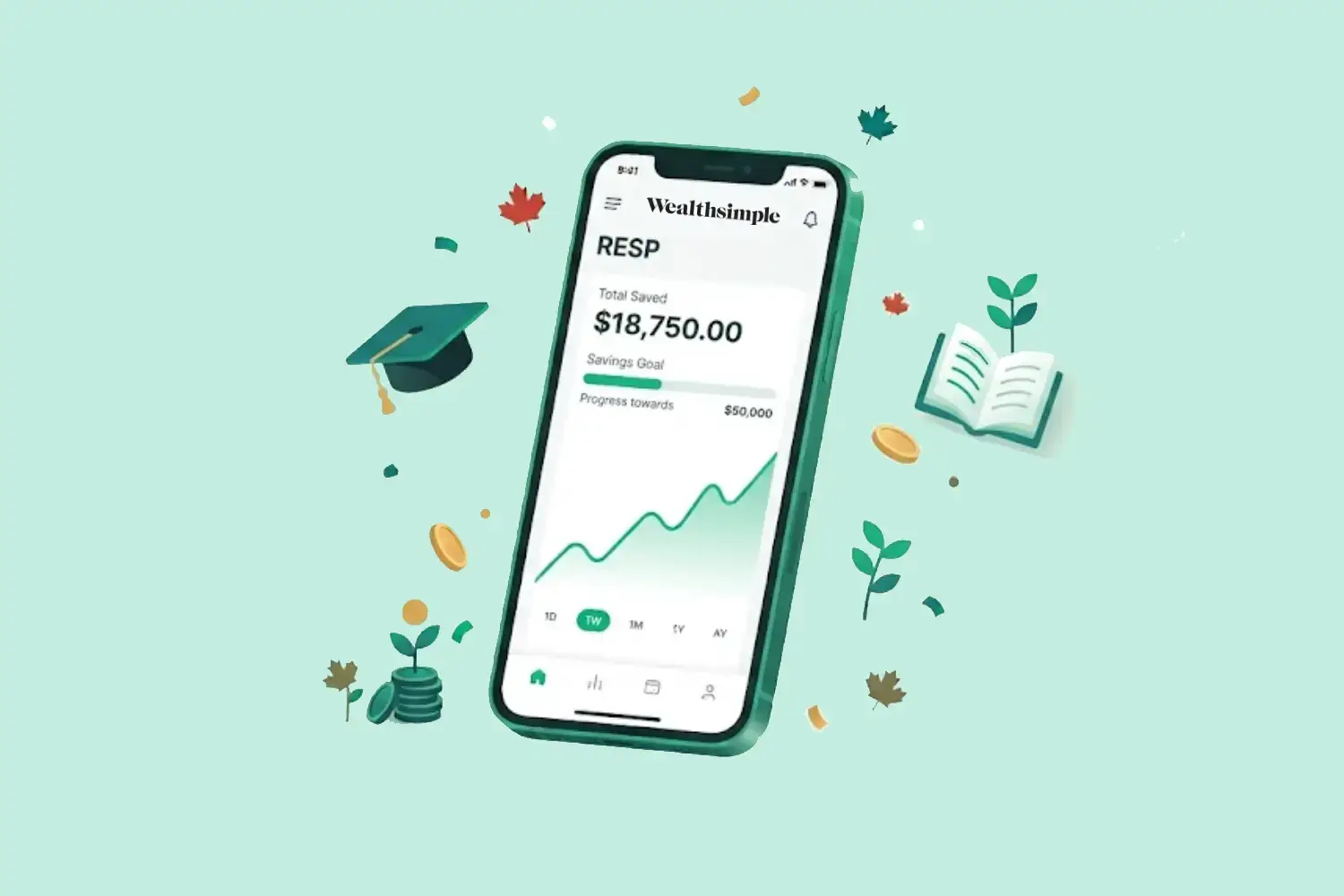
How the RESP works
- You contribute after-tax money toward a child's future education (contributions are not tax-deductible).
- The government adds grants on top of what you put in, this is the RESP's superpower.
- Growth is tax-sheltered, so dividends, interest, and capital gains compound with no annual tax.
- Withdrawals for school are taxed in the student's hands, usually at little or no tax because students have low income.
Inside the account you can either pick your own commission-free ETFs (self-directed) or let Wealthsimple build and manage a diversified portfolio matched to how many years are left until your child starts school, both with $0 commissions and no account minimum.
Government grants: CESG & CLB
The reason to prioritize an RESP is free money:
- Canada Education Savings Grant (CESG), the government matches 20% of your contributions, up to $500 per child per year (on the first $2,500 you contribute), to a lifetime maximum of $7,200 per child.
- Additional CESG, lower- and middle-income families can earn an extra 10–20% on the first $500 contributed each year.
- Canada Learning Bond (CLB), eligible lower-income families receive up to $2,000 per child with no contributions required at all.
Contributing $2,500 a year captures the full $500 CESG, a guaranteed 20% return on day one, before your investments earn a cent. Few opportunities in personal finance are this good.
Contribution limits & carry-forward
There's no annual contribution limit, but there is a $50,000 lifetime limit per beneficiary. The practical limit is set by the grant:
- The CESG is maximized on $2,500 of contributions per year.
- You can carry forward one year of unused grant room, so you can contribute $5,000 in a year to collect $1,000 in CESG (catching up one prior year).
- Starting early matters: spreading contributions out captures more grant years than a single large lump sum.
Individual vs family plans
An individual plan names one beneficiary and is open to anyone (parent, grandparent, family friend). A family plan can name multiple beneficiaries who are related to you by blood or adoption, and lets you share contributions and grants flexibly between siblings, handy if one child pursues a longer or more expensive program than another.
Taxes & withdrawals
When your child enrols in a qualifying program, money comes out in two streams. Your original contributions return tax-free (it was already after-tax money). The grants and growth come out as Educational Assistance Payments (EAPs), which are taxable to the student, and because students typically earn little, they often pay little or no tax on it.
What if your child doesn't go to school?
Your plans aren't locked in. Your contributions always come back to you tax-free. Unused government grants are returned to the government. The investment growth can often be moved into your RRSP (or a spousal RRSP) if you have contribution room, subject to conditions, instead of being withdrawn at a higher tax rate. A family plan also lets you redirect funds to a sibling.
How to open a Wealthsimple RESP
- Open wealthsimple.com/invite/_Y024Q to attach referral code _Y024Q.
- Create your account and verify your identity with photo ID and your SIN.
- Select RESP and add your child's details, including their SIN (required to receive grants).
- Deposit at least $100 from an external bank within 30 days.
- Your $25 bonus lands in your Chequing account within 24 hours of the deposit settling.
Start your child's education fund with a free $25.
Open an RESP with code _Y024QDoes the $25 bonus use RESP room?
No. As with every Wealthsimple account, the $25 referral bonus lands in your Chequing account, not the RESP, so it never touches the $50,000 lifetime limit or your CESG grant room. The RESP keeps every dollar working toward your child's education.
Wealthsimple RESP questions
Common questions about the RESP, grants, and the $25 bonus.