Wealthsimple FHSA
The First Home Savings Account is the best of both worlds: contributions are tax-deductible like an RRSP, and qualifying withdrawals for your first home are tax-free like a TFSA. Open one and claim $25 with code _Y024Q.
If you're saving for your first home, the FHSA is almost certainly where you should start. It's the only registered account that gives you a tax deduction on the way in and a tax-free withdrawal on the way out.
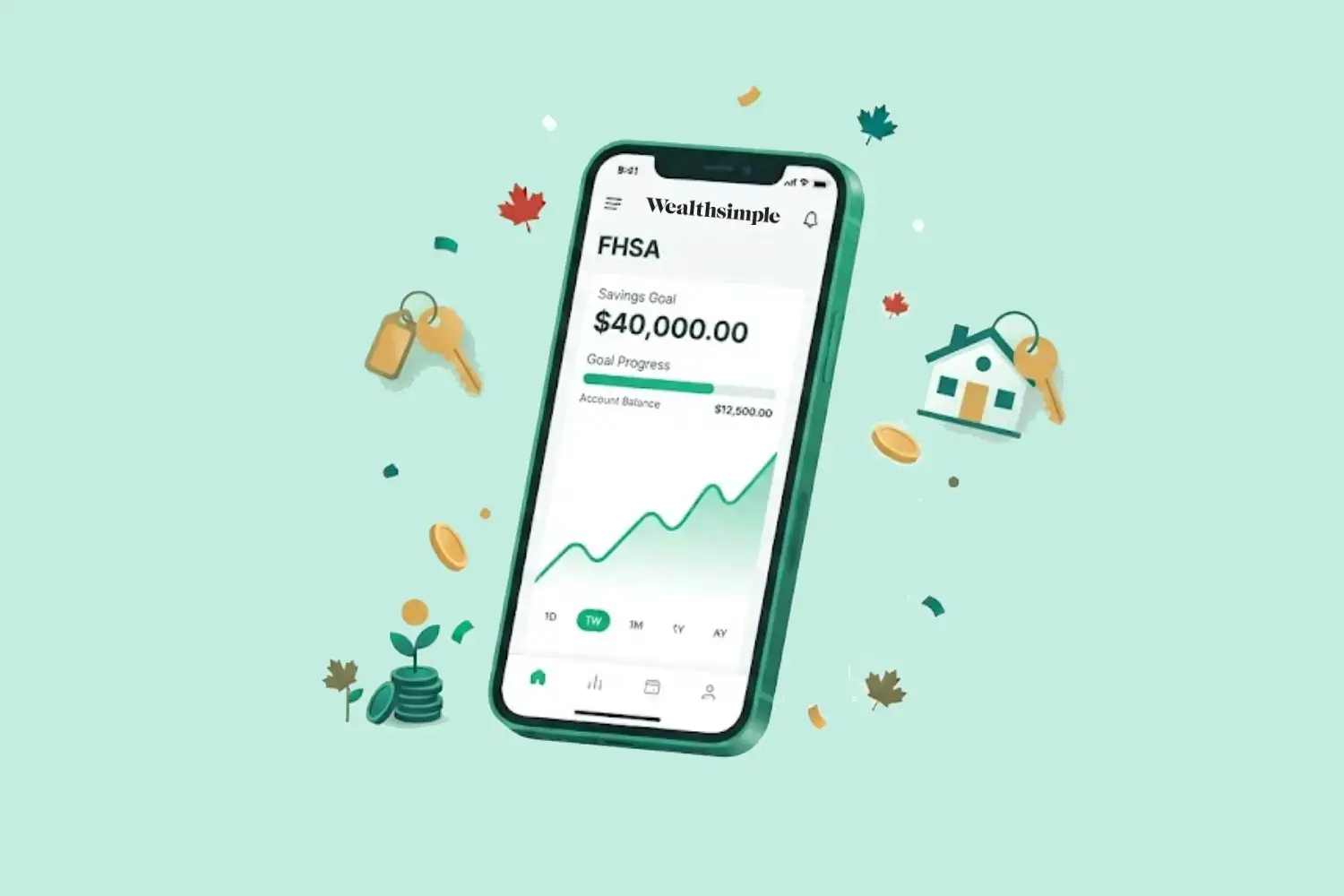
How the FHSA works
- Contributions are tax-deductible, just like an RRSP, they reduce your taxable income and can generate a refund.
- Growth is tax-sheltered, interest, dividends, and capital gains compound with no annual tax.
- Qualifying withdrawals are tax-free, when you buy your first home, you pay no tax on the money you take out, including all the growth.
That combination is unique. An RRSP gives you the deduction but taxes withdrawals; a TFSA gives tax-free withdrawals but no deduction. The FHSA gives you both, which is why, for eligible first-time buyers, it's usually the very first account to fund.
Contribution limits & carry-forward
You can contribute up to $8,000 per year, to a $40,000 lifetime maximum. The carry-forward rules have a twist worth understanding:
- Carry-forward room only starts accumulating after you open an account, so it pays to open one early, even with a small deposit.
- You can carry forward a maximum of $8,000 of unused room into the next year, letting you contribute up to $16,000 in a single year.
- Unlike the RRSP, contributions made in the first 60 days of a year cannot be applied to the prior tax year, FHSA contributions count for the calendar year they're made.
Opening an FHSA with even $1 today starts your 15-year clock and begins building carry-forward room, a smart, free move if home-ownership is anywhere on your horizon.
That 15-year clock is no longer theoretical. The first FHSAs opened in April 2023, so the earliest accounts have to be closed by December 31, 2038. If you opened one in the first wave, you are roughly a fifth of the way through the window.
You don't have to claim the deduction right away
This is the most underused feature of the account. Just like an RRSP, an FHSA deduction you don't claim carries forward indefinitely, even after the account itself closes. So if you contribute $8,000 during a low-income year, while you're in school or between jobs, you can bank the deduction and claim it in a later year when you're in a higher bracket and it's worth more.
The contribution still has to happen by December 31 to count for that year. Only the deduction waits. One catch to plan around: contributions you make after your first qualifying withdrawal can't be deducted in any year, so front-load before you pull money out. You'll also file Schedule 15 with your return to track your participation room.
Who's eligible?
To open an FHSA you must be:
- A Canadian resident;
- At least 18 (or the age of majority in your province) and under 71;
- A first-time home buyer, meaning you haven't lived in a qualifying home that you (or your spouse/common-law partner) owned during the current calendar year or the previous four calendar years.
Stacking the FHSA with the Home Buyers' Plan
One of the biggest wins is that you can use your FHSA and the RRSP Home Buyers' Plan on the same purchase. Between a maxed-out $40,000 FHSA (plus growth) and up to $60,000 from the HBP, a couple can assemble a six-figure, highly tax-advantaged down payment. Unlike the HBP, FHSA withdrawals for a home never have to be repaid.
What makes a withdrawal tax-free
The FHSA's headline benefit is the tax-free withdrawal, but it only applies to a qualifying withdrawal, and there's a checklist behind that word. You need all of the following:
- A written agreement to buy or build a qualifying home, with acquisition or construction completed before October 1 of the year after your first withdrawal.
- An intention to occupy the home as your principal residence within one year of buying or building it. There's no minimum period you have to live there.
- Canadian residency from the time of the withdrawal until you acquire the home.
- The withdrawal made no later than 30 days after you take possession.
You make the withdrawal by filing Form RC725 with the CRA. Get the sequence wrong and the money comes out taxable, so it's worth lining up the agreement before you touch the account.
What if you don't buy a home?
If your plans change, your FHSA savings aren't lost. You can transfer the full balance, including all growth, into your RRSP or RRIF tax-free and without using any RRSP contribution room. The account can stay open for up to 15 years (or until the end of the year you turn 71, whichever comes first). If you instead withdraw the money as cash for non-home use, it becomes taxable.
How to open a Wealthsimple FHSA
- Open wealthsimple.com/invite/_Y024Q to attach referral code _Y024Q.
- Create your account and verify your identity with photo ID and your SIN.
- Select FHSA as your account type and confirm your first-time-buyer eligibility.
- Deposit at least $100 from an external bank within 30 days.
- Your $25 bonus lands in your Chequing account within 24 hours of the deposit settling.
Start your first-home fund with a free $25.
Open an FHSA with code _Y024QDoes the $25 bonus use FHSA room?
No. Hold cash, ETFs, or a hands-off managed portfolio inside your FHSA with $0 commissions and no minimum. As with every account, the $25 referral bonus lands in your Chequing account, so it never eats into your $8,000 annual or $40,000 lifetime FHSA limits.
FHSA vs TFSA vs RRSP
For a first home, fund the FHSA first to capture both the deduction and the tax-free withdrawal. Use a TFSA for flexible goals where you may need the money back, and an RRSP for broader retirement saving (or to stack via the Home Buyers' Plan). All three qualify for the bonus.
Already have an FHSA at a bank? You can transfer it to Wealthsimple without touching your contribution room, and Wealthsimple automatically reimburses the outgoing institution's transfer fee on single-account transfers of $25,000 or more, up to $150, provided the account stays funded for 90 days. A transfer in from another institution also counts as qualifying funding for the $25 bonus.
Wealthsimple FHSA questions
Common questions about the FHSA, eligibility, and the $25 bonus.